THE AROMA OF LOVE
THE AROMA OF LOVE
I was one of the lucky kids whose mom baked bread. I came home from school to the aroma of warm bread filling every crevice of our Chicago bungalow. Of course, I didn’t know at the time that I was lucky. As a ten-year-old, I jealously watched my school friends open their lunchboxes to PB &J sandwiches made with Wonder bread. I longed for doughy white Wonder bread sandwiches.
We just don’t know what we have sometimes.
Fast forward some sixty years. My mother, now 99, has limited mobility and needs a caregiver with her full-time in her Michigan home. Although her body is weak, requiring a walker or wheelchair to get around, her mind is sharp, her heart tender. The rhythm of her days has changed, but Mom still embodies a faith-filled life of love.
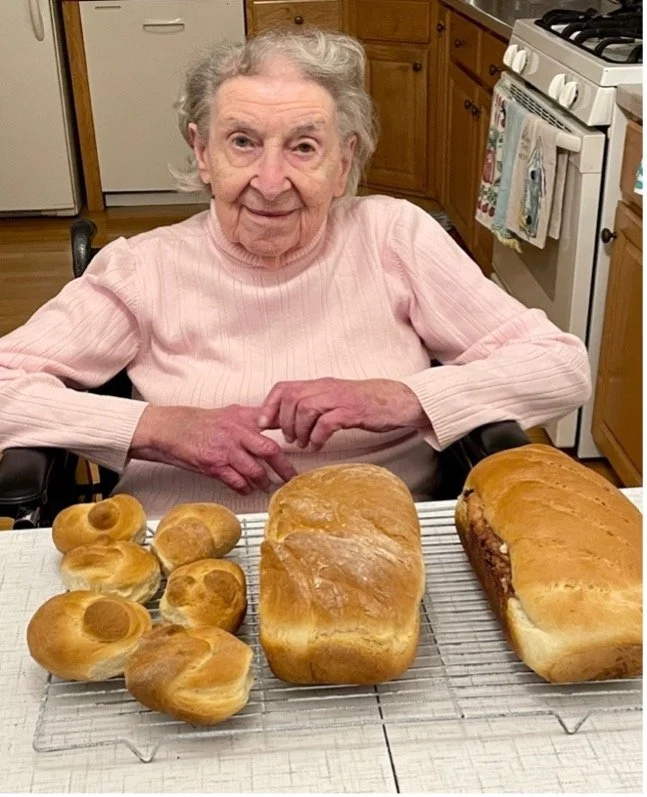
Some of my siblings and I take turns providing care for Mom. One weekend, my sister-in-law, Joyce, asked Mom if she might want to bake bread together. Mother leapt at Joyce’s lovely idea! They gathered the ingredients at the kitchen table, and Joyce pulled out Mom’s years-old recipe—an index card written in her graceful cursive, now faded. But it was not needed. Mom remembered each step, ingredient and its precise measurement, down to the seven cups of flour—scooped and leveled. The recipe was in her marrow.
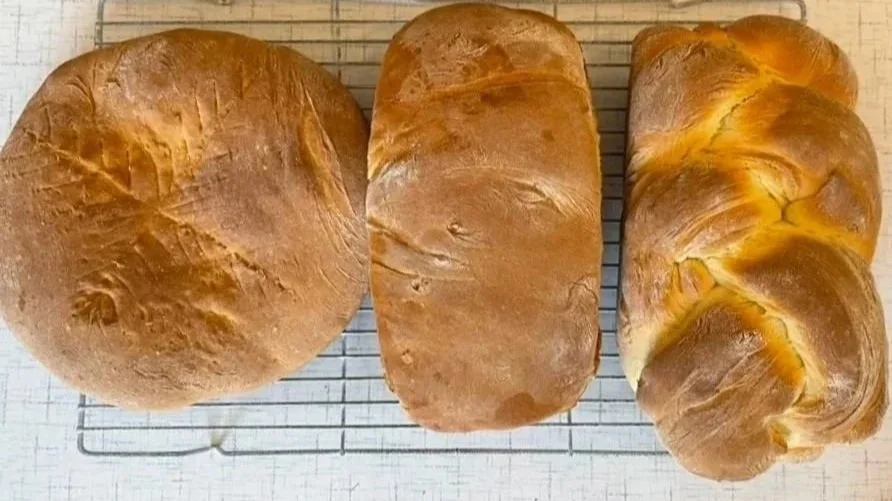
Mom and Joyce assembled the bread just as she had all those decades ago: they let the yeasty dough rise, punched it down, then let it rise again after they formed loaves. Then, the baking. Does anything smell more like love than baking bread? Thirty-five minutes later, the oven yielded two loaves of golden-brown bread and one cinnamon-raisin loaf—a thing of beauty when toasted for breakfast.
When Joyce asked Mom the last time she had baked bread, she paused, then remembered, tears in her eyes. “The last time was when Dad was dying. He always loved the smell of my bread baking. I wanted him to smell it again.” The aroma of love wafted into the bedroom of her beloved husband of 52 years, who lay dying from a brain tumor. A whiff of God’s life-giving, pouring-out love. A sacrament of love, in bread form. The body of Christ, broken for you.
Dad’s sense of smell, that most instant of memory inducers, was still intact. In what was left of Dad’s 82-year-old, cancer-ravaged body, he once again came home to the warm embrace of baking bread. He was, just once more, reliving love.
It could not have been easy for Mom to bake those loaves of bread, knowing her beloved would never eat a slice. Clever and compassionate Mother, she was loving him the best way she knew: there, in the kitchen, with flour and oil, sugar and salt.
Love wills—and works for — the good of the other.
This is now family lore, of the best sort.
Mom’s simple act of love stands in sharp contrast to the cultural moment’s Wonder bread imitations. Every age has its versions of artificial love—the flavor of the day tilts further and further toward a narcissistic clamoring for admiration. “Love” as getting, not giving. What’s in it for me? David Brooks writes of today’s wrong-headed love, describing “the feeling they get when somebody satisfies their craving for positive and tender attention, not as something they selflessly give to another” (The New York Times, August 28, 2025).
We swim in highly individualized, self-centric waters, where “you do you” is the ethos. Genuine love can be hard to recognize.
I’d love to point my finger only outward, but honestly, how often have I taken my desire for love to lesser places? Given the choice to go beyond my needs — for example, to help a friend move, or to show embodied friendship in hundreds of ways—do I indulge my tendency to curve in on myself, or to love?
Mom’s self-emptying love is anything but sentimental or merely “sweet.” Rather, it points to a deeper, truer Story, a story of cruciform love, of one choice at a time made with the other in mind.
Before she baked those last loaves for Dad, Mom had rehearsed real-life love countless times. Hers has been a long obedience in the same direction, as Eugene Peterson wrote. She joins in the great dance of our Trinitarian God of Love, to do in her what she cannot do in her own strength. Leaning on Grace in all kinds of moments, not only when she felt like it. When it cost her something. Especially when it cost her something. Her mind and heart have been formed, like loaves, in the way of Jesus—gradually, not perfectly. She is still doing that dance.